Beschrijving
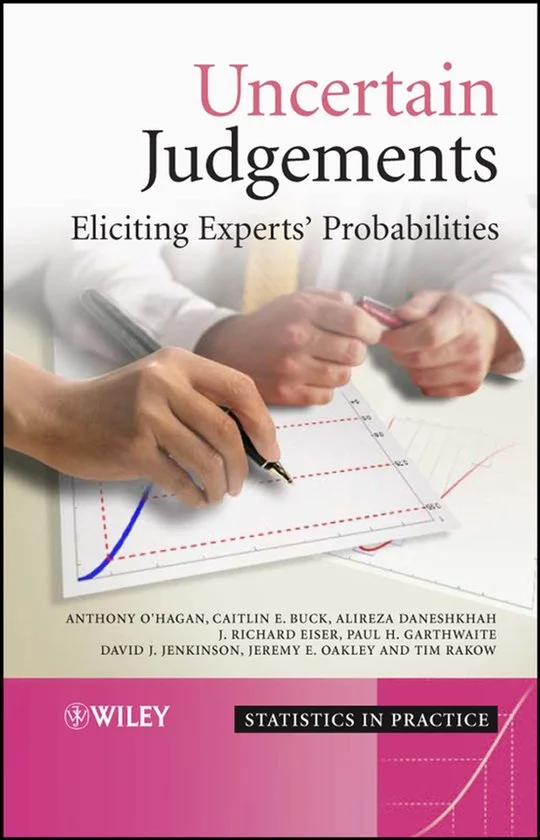
Uncertain Judgments Eliciting Experts’ Probabilities presents a range of tried and tested elicitation methods to enable statisticians to get make the most of expert opinion. An elicitation method forms a bridge between an expert’s opinion and an expression of these points in a statistically useful form.
Elicitation is the process of extracting expert knowledge about some unknown quantity or quantities, and formulating that information as a probability distribution. Elicitation is important in situations, such as modelling the safety of nuclear installations or assessing the risk of terrorist attacks, where expert knowledge is essentially the only source of good information. It also plays a major role in other contexts by augmenting scarce observational data, through the use of Bayesian statistical methods. However, elicitation is not a simple task, and practitioners need to be aware of a wide range of research findings in order to elicit expert judgements accurately and reliably. Uncertain Judgements introduces the area, before guiding the reader through the study of appropriate elicitation methods, illustrated by a variety of multi-disciplinary examples.
This is achieved by:
- Presenting a methodological framework for the elicitation of expert knowledge incorporating findings from both statistical and psychological research.
- Detailing techniques for the elicitation of a wide range of standard distributions, appropriate to the most common types of quantities.
- Providing a comprehensive review of the available literature and pointing to the best practice methods and future research needs.
- Using examples from many disciplines, including statistics, psychology, engineering and health sciences.
- Including an extensive glossary of statistical and psychological terms.
An ideal source and guide for statisticians and psychologists with interests in expert judgement or practical applications of Bayesian analysis, Uncertain Judgements will also benefit decision-makers, risk analysts, engineers and researchers in the medical and social sciences.